Move beyond fragile OCR templates to schema-constrained multi-modal extraction
Insurance carriers, legal intake desks, and commercial lenders process thousands of unstructured PDFs, medical invoices, repair estimates, and scanned endorsements every week. Legacy regex templates break whenever a vendor changes a table layout, while unconstrained LLM prompts hallucinate policy numbers or misread line-item totals.
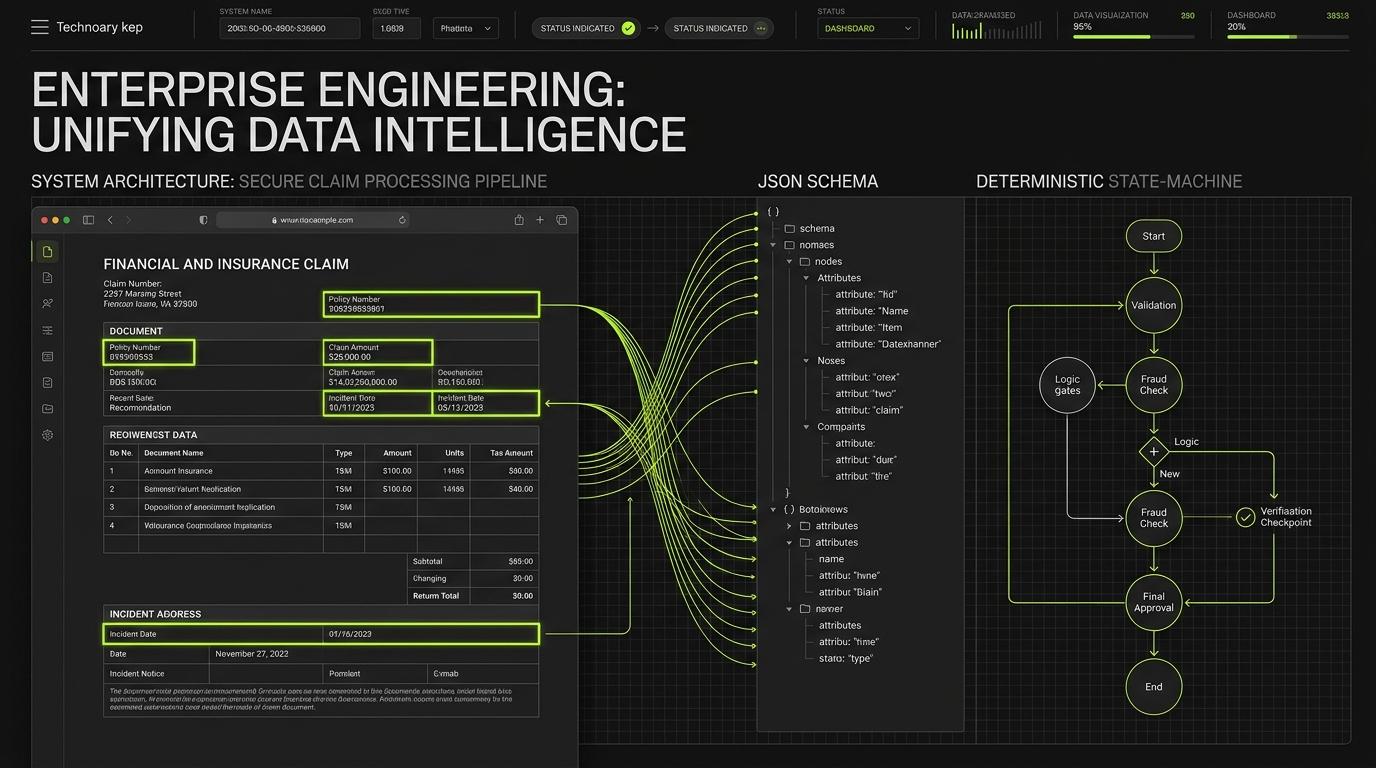
When Radiaix engineered Luxe Claim and the TUIC Insurance Portal, we replaced brittle template matching with a two-stage document intelligence pipeline: layout-aware vision parsing paired with strict JSON Schema extraction and bounding-box coordinate citations.
- Normalize incoming multi-page PDFs, mobile photos, and email attachments into page-indexed document graphs.
- Enforce strict JSON Schema output contracts with field-level confidence scores and source page coordinates.
- Cross-check extracted line items mathematically (subtotals, tax rates, deductibles) before downstream database writes.
- Flag low-confidence handwriting or damaged scans immediately for targeted operator verification.
Separate probabilistic document extraction from deterministic policy rules
A foundational architectural rule at Radiaix is that foundation models extract and classify evidence, but deterministic code evaluates financial and coverage eligibility. Mixing coverage arithmetic inside an LLM prompt makes regulatory audits impossible.
Once our extraction pipeline structures a claim packet into typed entities, a deterministic policy rules engine validates coverage dates, policy exclusions, deductible thresholds, and duplicate-claim hashes against the core system of record.
Use AI to turn unstructured evidence into structured facts—then use deterministic state machines to adjudicate policy rules with 100% repeatability.
Design side-by-side human-in-the-loop review queues with source highlighting
Even when 70% of routine submissions pass straight-through validation, complex or high-value claims require senior adjuster sign-off. If an adjuster has to hunt through a 40-page PDF to verify why the AI flagged an exclusion, automation has failed.
Radiaix designs split-pane adjudication workspaces where clicking any extracted field immediately scrolls the embedded document viewer to the exact page and highlights the source bounding box—allowing adjusters to approve, override, or escalate a claim in seconds.
- Link every extracted value directly to its source page and bounding-box highlight in the document viewer.
- Provide one-keystroke keyboard shortcuts for approving verified fields or requesting claimant re-uploads.
- Capture adjuster overrides as labeled training feedback to continuously benchmark extraction accuracy.
- Maintain an immutable, timestamped audit log of both automated checks and human adjudication decisions.
Benchmark extraction precision and latency before every production deployment
Document layouts drift seasonally as hospitals, repair networks, and brokers update their forms. Radiaix ships every document intelligence platform with an automated golden-dataset evaluation harness that measures field-level precision, recall, and p95 latency on every model or prompt update.
Combined with end-to-end Playwright workflow verification, our engineering teams ensure that neither a model upgrade nor a UI release can silently degrade claims throughput or compliance accuracy.
How Radiaix Automated Claims Intake & Underwriting Workflows for Luxe Claim and TUIC
Claims adjusters and underwriters were spending hours manually keying multi-page PDF packets, cross-referencing policy exclusions, and chasing missing claimant documentation.
Radiaix engineered schema-constrained AI document extraction pipelines, deterministic coverage validation engines, and split-pane adjuster review portals.
Key Engineering Takeaways
Related Radiaix Systems, Services & Technical References
Explore how Radiaix scopes and deploys bounded enterprise AI agents and document pipelines.
See how Radiaix streamlined claims intake, verification, and settlement tracking.
Inspect Radiaix's custom underwriting and policyholder portal architecture.
Read our foundational guide on scoping human-in-the-loop AI workflows and guardrails.
Industry standard governance framework for trustworthy, auditable enterprise AI systems.
Frequently Asked Questions
How does Radiaix prevent AI hallucinations in financial and insurance document extraction?
We enforce strict JSON Schema validation, require page and bounding-box source citations for every extracted value, run deterministic arithmetic cross-checks on line items and totals, and route any low-confidence field to a human-in-the-loop review queue.
Can Radiaix integrate AI document pipelines with our existing policy administration or ERP system?
Yes. Radiaix builds secure webhook, REST, and queue-based integrations that sync validated document payloads and audit trails directly into your existing core insurance, healthcare, or ERP databases.